Monarch Update: Summer 2026
The latest data on eastern monarch butterfly populations reveals encouraging progress for the second consecutive year. According to the World Wildlife Fund (WWF) Mexico and Mexico's National Commission of Protected Natural Areas (CONANP), the total forest area occupied by overwintering colonies expanded to 2.93 hectares (7.24 acres) during the 2025–2026 winter season. This represents a 64% increase from the 1.79 hectares (4.42 acres) reported last year. [1, 2, 3]
Researchers identified nine distinct colonies clustering in central Mexico's oyamel fir forests—three located in Michoacán and six in the Estado de México. Five of these colonies safely established themselves inside the Monarch Butterfly Biosphere Reserve (MBBR), while four settled in the surrounding forest zones outside of the reserve. This continued upward momentum marks the largest overwintering population recorded in seven years, solidifying a recovery trend after severe declines between 2022 and 2024. [2, 4, 5, 6, 7]
Understanding the Numbers & Trends
Because counting individual butterflies is impossible across dense winter clusters, scientists measure the population status by calculating the exact physical area of trees turned vibrant orange by the colonies. [2, 8, 9]
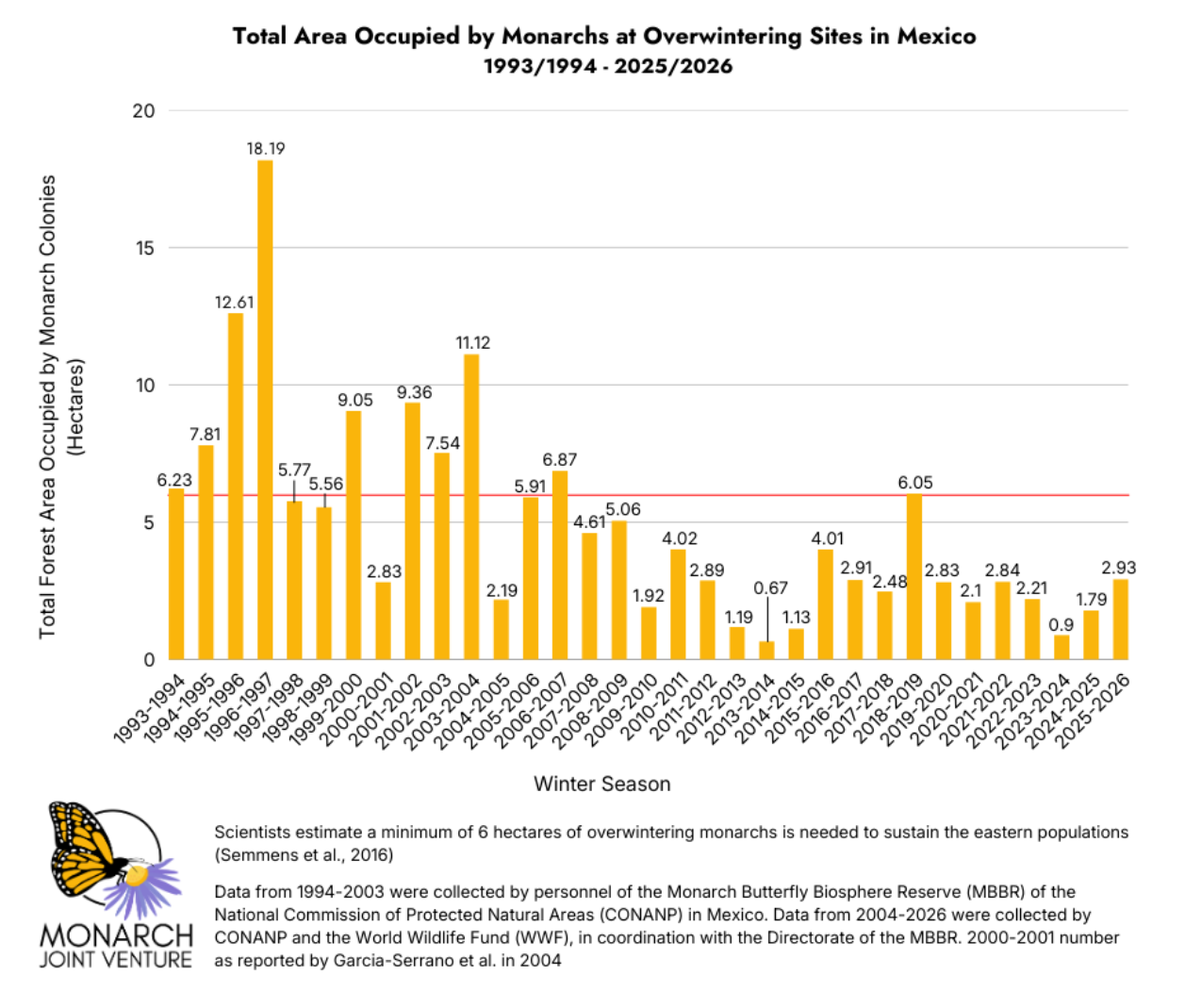
While this 2.93-hectare occupancy is slightly above the 10-year historic average of 2.81 hectares, conservation biologists emphasize that the species is not out of the woods yet. Experts at the Monarch Joint Venture and partner organizations point out that a sustained minimum of 6 hectares (15 acres) of forest coverage is required to ensure the long-term survival and genetic safety of the species. [3, 11, 12]
Environmental Factors and Future Outlook
Favorable weather conditions and reduced intense droughts along the migratory corridors in Canada and the United States provided excellent support for the butterflies' breeding success leading up to this season. Furthermore, dedicated regional collaboration has virtually eliminated illegal logging within the core zone of the MBBR, allowing the necessary winter microclimates to remain intact. [4, 9, 12]
Despite these victories, the monarch migration remains delicate due to the persistent threat of climate change, localized extreme weather events, and widespread habitat loss of essential nectar plants and milkweed. Sustaining this multi-year comeback requires expanding pesticide-free pollinator habitats from urban backyards to vast public lands. [11]
Report Reference: 2025 Monitoreo Mariposa Monarca en México 2025-2026
WWF Story: Eastern monarch overwintering population increases from last year [2, 13]
[1] https://www.cals.iastate.edu
[2] https://monarchjointventure.org
[3] https://monarchconservation.org
[4] https://www.worldwildlife.org
[7] https://www.elfinanciero.com.mx
[8] https://monarchjointventure.org
[11] https://news.mongabay.com
[12] https://www.theguardian.com
[13] https://xerces.org